What AI News From the October 2026 Weekly Recap Changes How You Work
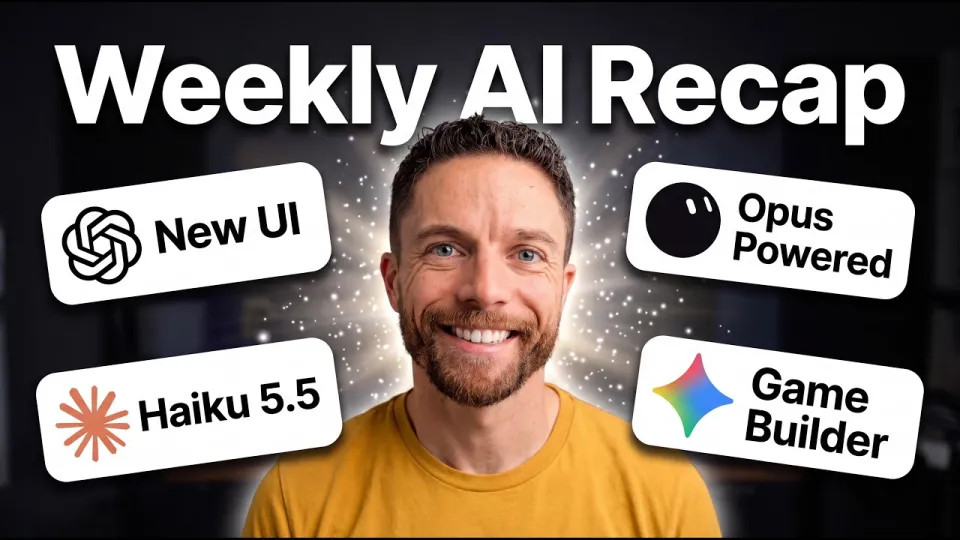
Video: Weekly AI Recap: GrokBot Just Did the Unthinkable, ChatGPT Looks Completely Different & More!
Need articles like this for your video? They help promote it on YouTube and Google — order them in the Telegram bot @sat_sit_bot. Articles with your video embedded are written and posted by the bot itself — on popular topical sites (no ads). Try it free: 50 articles on us.
· based on the channel Paul J Lipsky
AI news this week centers on one shift: assistants are turning into orchestrators that route work across several models and tools. The October 2026 weekly recap from Paul J Lipsky tracks Grok Bot's plan to call Claude, Midjourney and Suno, ChatGPT's new Intelligent UI, Claude Cowork's move to the cloud, and Google's Gemini and Nano Banana updates. The episode is sponsored by Okou, and you can try Okou and claim the launch offer with promo code KJZN8RVG for 20% off one month of a Pro or Team plan, limited to 100 redemptions.
Grok Bot stops pretending to be one model
The headline item is that Grok Bot is being built as a router rather than a single chatbot. Instead of answering everything with one underlying model, it can hand a task to Claude for reasoning and writing, to Midjourney for images, and to Suno for audio, then assemble the results into one output. That is a meaningful architectural change: the assistant becomes a project manager, and the quality of the final deliverable depends as much on task decomposition as on any single model's benchmark score.
Why this matters in practice:
- You describe an outcome, not a tool. Asking for a finished social video is different from asking for a script, then an image, then a voice track.
- Model choice becomes invisible. The user no longer needs to know which vendor is best at which subtask.
- Errors compound. If the router misreads the brief, every downstream step inherits the mistake, so review checkpoints still matter.
- Cost and latency get harder to predict, because one request may trigger several paid calls.
The most concrete evidence of this working comes from a viewer who described handing Grok Bot a link to a Google Photos folder full of raw business videos, plus instructions for the social clip they wanted. According to that account, the bot produced a voice script, accepted the recorded audio back, and returned a better result than the outsourced edit it replaced. Treat that as one anecdote, not a benchmark, but it is exactly the workflow the orchestration pitch promises.
ChatGPT's Intelligent UI changes the surface, not just the model
ChatGPT now looks completely different because OpenAI is shipping an Intelligent UI that reshapes the interface around the current task. Rather than one universal chat box, the layout can surface the controls, canvases and artifacts that fit what you are doing, whether that is writing, analysis, image work or code. The underlying models still matter, but interface friction has been a real reason people abandon AI tools, so this is a product decision as much as a research one.
What to watch when you try it:
- Whether your saved prompts and custom instructions survive the redesign intact.
- Whether the adaptive layout hides options you relied on, such as model pickers or file attachments.
- Whether team members on different rollout stages see the same thing, which affects shared documentation.
For teams, the practical advice is to re-record your internal how-to guides after the interface settles. Screenshots of the old layout become misleading fast.
Claude Cowork moves agent work into the cloud
Claude Cowork is Anthropic's push toward shared, multi-step agent work, and the change this week is that it runs in the cloud. That removes the requirement that someone's laptop stay open and connected for a long job to finish, and it makes handing a task to a colleague far simpler because the workspace is not tied to one machine.
The trade-offs are ordinary cloud trade-offs: you gain persistence and collaboration, and you take on questions about what data leaves your device, who can see a running task, and how usage is metered when an agent keeps working after you close the tab. Before moving a real workflow over, check which folders and accounts the agent can reach and whether the output lands somewhere your team already reviews.
Google's week: Gemini plans and Nano Banana 2.1
Google's segment covers changes to Gemini subscription plans and the Nano Banana 2.1 image model. One viewer noted that a Google AI Plus plan includes 2TB of storage alongside access to the Pro model, which is the kind of bundled detail that decides whether an upgrade is worth it. Plan restructuring is rarely exciting, but it changes which model tier you can reach and how much you pay for it, so read the tier comparison before renewing anything.
On the image side, Nano Banana 2.1 continues Google's rapid iteration on generation and editing. The useful test is not a pretty demo prompt but your own repetitive task: a product shot that needs a background swap, a diagram that needs relabeling, a thumbnail that needs three variants. Run that task on the new model and compare against whatever you used last month.
Questions viewers keep asking about this stack
The comments under the recap show where the confusion actually sits, and most of it is about adoption rather than model quality. Three patterns stand out.
First, discoverability. One viewer deleted a newly appeared "primary" bot because nobody had explained what it was, and assumed another bot had gone rogue. New autonomous surfaces need clear labeling and an undo path, or cautious users will remove them defensively.
Second, the non-technical gap. The most-liked request in the thread was for a Claude Code walkthrough aimed at people who do not write software. Agentic coding tools are leaking into operations, marketing and research work, and the documentation has not caught up.
Third, appetite for format. Viewers repeatedly said the day-by-day structure is what makes a week of scattered releases usable, because it keeps Grok Bot, ChatGPT, Anthropic and Google updates from blurring together.
How to test any of this in an afternoon
Pick one real deliverable you already owe someone, and run it end to end through the new tooling rather than trying demo prompts. A reasonable sequence:
- Write the brief as an outcome, including format, length and audience.
- Let the orchestrator decompose it and inspect the plan before it executes.
- Supply your own source material, such as a folder of clips or a document, instead of letting the model invent inputs.
- Review the intermediate artifacts, not just the final file.
- Time the run and note the cost, so you can compare it against your current process.
If the result needs heavy correction, the bottleneck is usually the brief, not the model. Rewrite the instructions with explicit constraints and run it again before drawing conclusions.
The takeaway
The through-line of this week's AI news is consolidation: Grok Bot wants to coordinate other vendors' models, ChatGPT is redesigning the interface around tasks, Claude Cowork is moving agent work off local machines, and Google is reshuffling plans and image models. None of these are pure model-quality stories; they are about where the work happens and who controls the routing. Paul J Lipsky's weekly recap is a efficient way to see those threads side by side, and the channel's day-by-day format is what makes the volume manageable. If you want to test the orchestration trend yourself, start with Okou through this link and use code KJZN8RVG for 20% off one month of Pro or Team while the 100 redemptions last.
Key takeaways
- Grok Bot is positioned as an orchestrator that can call Claude, Midjourney and Suno instead of relying on a single model.
- ChatGPT rolls out an Intelligent UI that adapts the interface to the task instead of showing one fixed chat window.
- Claude Cowork moves to the cloud, so multi-step agent work no longer depends on a local machine staying awake.
- Gemini's plan structure and Nano Banana 2.1 image model are the Google-side changes covered in the recap.
- A viewer reports handing Grok Bot a Google Photos folder of business videos and getting a finished social clip with a voice script back.
Questions & answers
What is Grok Bot actually doing differently from a normal chatbot?
It is being positioned as an orchestrator that can route parts of a task to Claude, Midjourney and Suno, then combine the results. In practice you describe a finished deliverable rather than prompting each tool separately. The catch is that a misread brief propagates through every downstream step, so checkpoints still matter.
Is the new ChatGPT Intelligent UI going to break my saved prompts and workflows?
Your prompts and custom instructions are the part most likely to carry over, while the layout around them changes. The risk is that controls you depended on, like model pickers or attachments, move or get hidden. Re-check your internal how-to guides after the rollout reaches your account, since screenshots of the old interface go stale quickly.
What does Claude Cowork running in the cloud mean for privacy?
It means a long agent task can keep running after you close your laptop, and colleagues can pick it up from another machine. Before moving real work over, confirm which folders and accounts the agent can access, who can view a running task, and how usage is billed when it continues unattended.
Do I need to know how to code to use agentic tools like Claude Code?
No, but you need to be precise. The most requested tutorial in the discussion around this recap was a non-technical walkthrough of Claude Code, which reflects how many operations and marketing people now use these tools. Start with one small, well-specified task and review each intermediate output rather than accepting the final result unread.
Source: Weekly AI Recap: GrokBot Just Did the Unthinkable, ChatGPT Looks Completely Different & More! · Markdown version